
How will East Park make most of its money? And how ‘clean’ will the electricity it sells be?
The government’s push for large-scale solar and battery energy storage developments is being pitched to communities as a route to cheap, clean power. But new evidence suggests solar/battery hybrid projects like East Park Energy may be driven far more by investor profits than by lowering household bills.
A recent Telegraph investigation describes the rapid expansion of battery energy storage as a new “net zero gold rush”, fuelled by the ability of battery operators to buy electricity cheaply off-peak and sell it back to the grid when prices spike, as well as for contracted ‘grid services’. Energy Editor Jonathan Leake explains that batteries turn electricity into a tradeable commodity, using a simple strategy of “buy low and sell high”. The Telegraph reports that this strategy accounts for about 60% of the income from battery systems.
The article quotes a professional at the law firm which has advised some of the UK’s largest battery projects who says that battery tech has a financial ‘X’ factor appeal for investors: “The trading has a lot of an oil and gas feel to it, rather than a renewables flavour … a lot of the people trading in battery storage flows are ex-oil and gas traders”. The Telegraph adds that estimates suggest that typical annual returns on battery systems are “around 15pc … far above bank rates and much better than the roughly 10pc that might be expected from a solar or onshore wind farm”. According to the Telegraph: “All of that is also guaranteed for years to come by charges on business and consumer bills.”
This profit model sits at the heart of new analysis from renewable energy policy expert Professor Tony Day, whose latest report challenges claims that grid-scale solar will deliver cheap electricity. Solar/battery hybrids are now the dominant model in the large-scale solar sector: around 90% of projects combine the two types of tech. But Professor Day’s analysis shows that once large, expensive lithium-ion battery systems are co-located with solar schemes, electricity sold by commercial solar farms could cost more than 75% above the headline solar price, pushing it well above the past year’s average grid price.
“Solar only looks cheap if you ignore what it takes to make it usable,” Professor Day warns. “The real money isn’t in cheap electricity – it’s in holding power back and selling it when prices are highest”.
As the Telegraph puts it, battery systems effectively allow solar operators to “supercharge the profits … encouraging their proliferation across top quality farmland.”
Crucially for communities facing proposals like East Park Energy, these lithium-ion batteries are not restricted to storing local solar power. Current market rules allow operators to charge batteries using electricity from any source on the grid – including gas – before selling it back at peak prices, a practice the report describes as an unchecked “backdoor subsidy” for developers.
Brockwell Storage and Solar, the developer behind East Park, has made it clear it will not just be using its planned 96-unit co-located battery storage system for curtailment management: the battery containers housed in a sizeable concrete compound would be “capable of exporting and importing up to 100MW.” Import capability – drawing electricity from the grid – is critical for energy trading and lucrative contract grid services.
The Telegraph article notes growing anger in countryside communities over the industrialisation of farmland, the clustering of battery storage compounds near grid connections, and fears over fire risks after multiple lithium-ion battery blazes across the world – and at least four so far in the UK.
For those in the community opposing East Park Energy, the new findings on battery operations reinforce a central concern: that vast areas of productive farmland could be sacrificed not to deliver cheap, clean power, but to enable highly profitable energy trading and services that keep prices high.
As report author Professor Day puts it: “What this market actually rewards is scarcity and volatility. Consumers could face higher bills, more countryside will be lost, and grid-scale solar power will still barely move the dial when we need it most”.
Related research reveals that even once the government’s 75GW solar power fleet is built by 2035, it would contribute as little as 13% to national annual electricity demand, collapsing to just 2–3% in winter months. Achieving the 75GW target would mean losing agricultural land with around the same footprint as Greater London.
9 February 2026
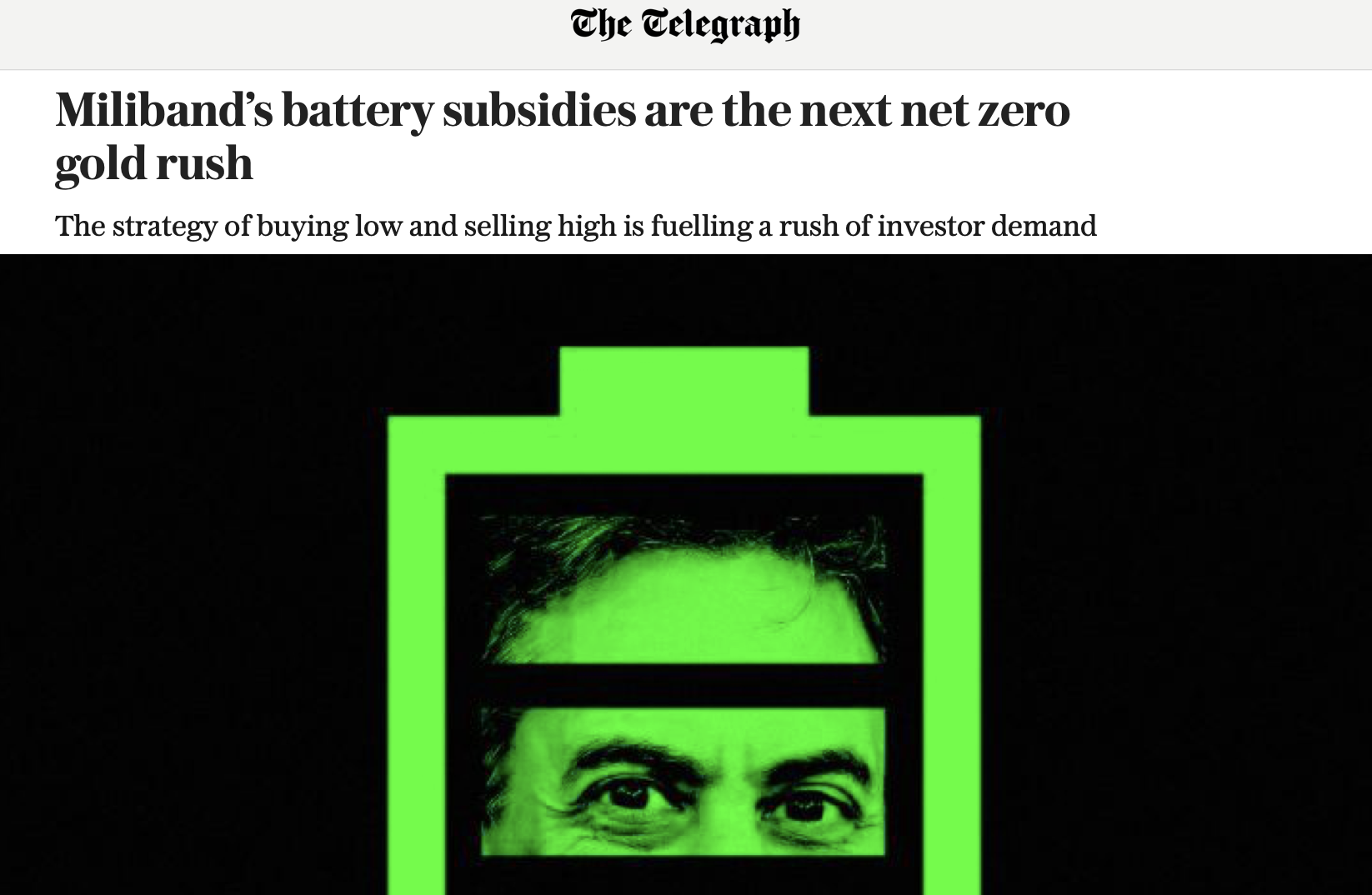
©️The Telegraph
Why does it matter how a private sector developer makes its profits?
In the recent Parliamentary Adjournment Debate on East Park with Energy Minister Michael Shanks, local MP Richard Fuller said: “…the combination of solar-generated energy and energy price arbitrage via battery energy storage systems fundamentally changes the economic case for solar – certainly from a public benefit point of view.”
Developers like Brockwell Storage and Solar, applying to build East Park, will argue that how they plan to use their battery storage assets is an operational matter. But there are three key reasons why battery operations are a material consideration in their planning applications:
- Battery profits will make up for poor solar power yields. This goes to the heart of the issue with grid-scale solar power in this country. In our climate, average yields across the year are lower than in other countries. A solar farm in Spain can produce almost double the electricity of an equivalent solar installation operating on British soil. For much of the time across autumn and winter months, solar arrays are effectively a ‘stranded asset’ in the UK, generating fractions of their massive nameplate capacities. The poor average annual output means that investors behind grid-scale solar schemes need to see their returns come from battery operations across the year, but especially in the low yield months – making it tough to justify thousands of acres of farmland being taken out of production for the solar power infrastructure that will sit largely in the background for extended periods each year.
- Electricity imported from the grid will be from any source. The electricity being stored or traded in schemes like East Park Energy’s battery banks will come from any source on the grid – gas, wind, nuclear, whatever is cheap at the time. Gas plants will be needed to provide back-up for intermittent, weather-dependent renewables. How much of the time will the electricity imported by battery systems from the grid be gas-generated? It will be difficult to claim that battery operations like East Park’s will be dealing exclusively in ‘clean’ energy. But all the solar NSIP developers base their projects on national policy strongly supporting ‘clean’ power. This policy support is fundamental to the success of their applications which allow them not only to over-ride local concerns and community considerations, but grant them sweeping compulsory purchase powers over farmland.
- The cost of electricity sold by solar/battery hybrid sites could rise. Ultimately, the higher profits developers like East Park will make via their battery operations – trading and grid services – could end up reflected in energy bills. Again, the national policy support that solar NSIP developers rely on is clear that power should be “affordable” or “low cost”.
 Stop East Park Energy