
The East Park Energy proposal is on such a massive scale that it has to go through a complex and lengthy national level application process. It’s known as a Nationally Significant Infrastructure Project (NSIP), requiring a Development Consent Order (DCO), which is a specific type of planning application that is used for large infrastructure projects such as the Luton Airport expansion and the Thames Tideway Tunnel. The Planning Inspectorate (PINS) handles these applications. A decision on the East Park Energy proposal will ultimately be made at a high national level, by at least one Secretary of State. Look at the application page on the portal here.
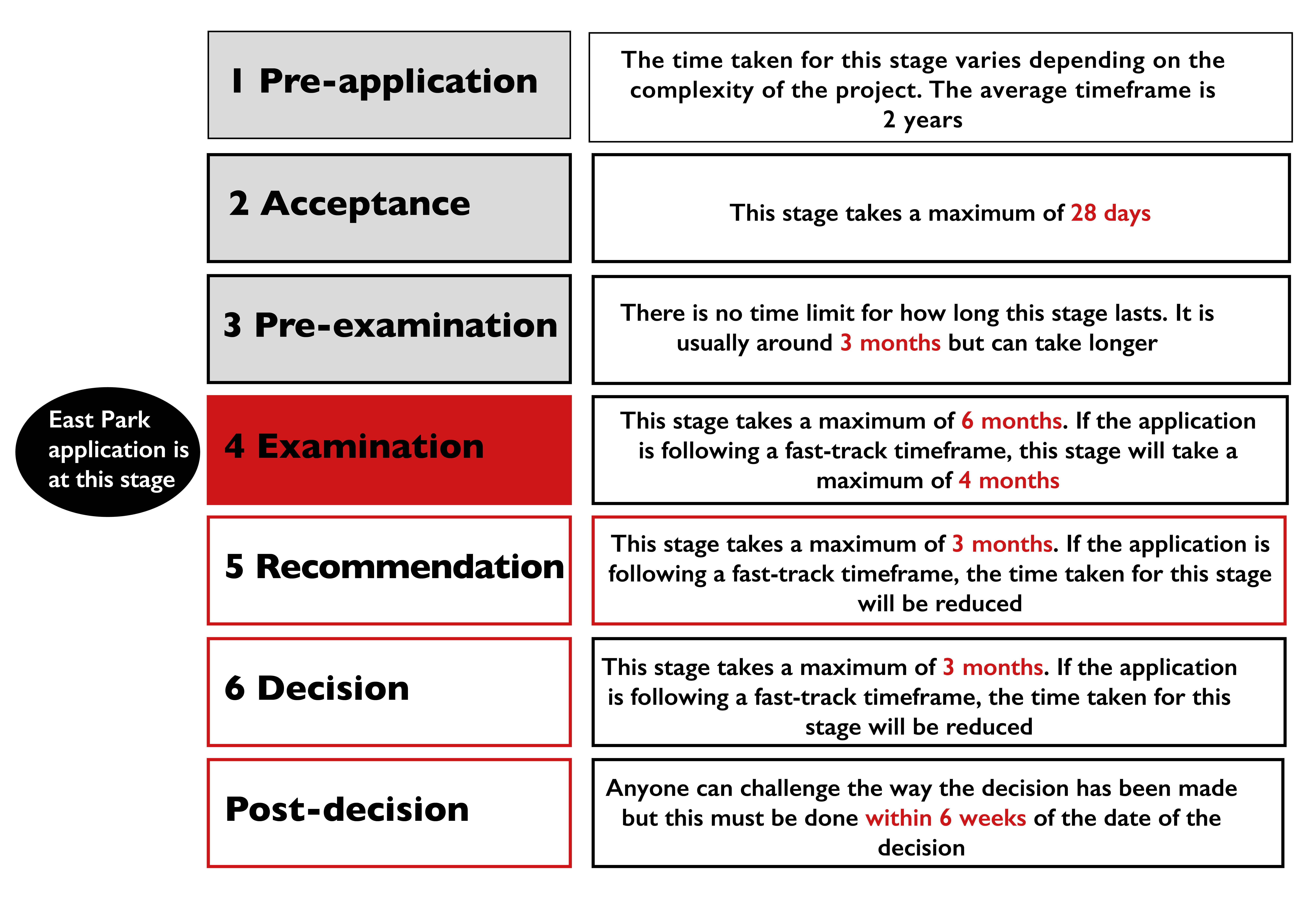
How the PINS process works
There are six stages to this complex process. It is known to be ‘front loaded’ so the best opportunities to influence are during the early stages. Once an application has been submitted, there is little scope to change or influence the contents of the proposal.
Pre-application
Before they submit an application, applicants have to consult on their proposals – it’s a statutory duty. The time this takes depends on the proposal’s scale and complexity.
At the pre-application stage, PINS can’t consider any representations on the merits – or otherwise – of the proposed application.
East Park Energy is currently in the pre-application period – you can see the pre-application documents already on the PINS website. The developer originally stated that it intended to make a formal application in Q1 2025, but has now changed its application timeframe to Q3 2025.
Acceptance
This stage starts when the applicant submits an application for ‘development consent’ to PINS. The Inspectorate then has up to 28 days to decide, on behalf of the Secretary of State, whether or not the application can be accepted for examination. This includes whether all suitable documentation has been received and whether the community consultation was adequate.
Pre-examination
At this stage, anyone can register with PINS to become an ‘interested party’ by making a ‘relevant representation’. This is a summary of a person’s views, in writing. Registration to become an ‘interested party’ should be open for at least 28 days and everyone must register within this period.
An ‘examining authority’ is appointed at this stage. One of their roles is to decide which Secretary or Secretaries of State will consider the recommendation. It is not unusual for two Secretaries of State to make the decision jointly – for example, for an airport expansion, both Transport and Levelling Up may be called on. They could be:
- Secretary of State for Energy Security and Net Zero – on the basis that it is a solar project
- Secretary of State for Levelling Up, Housing and Communities – on the basis that it is a planning decision
- Secretary of State for Environment, Food and Rural Affairs – on the basis that it involves the redesignation of farmland
All interested parties will be invited to a ‘preliminary meeting’.
There is no statutory timescale for this stage, but it usually takes around three months from the applicant’s formal notification and publicity of an accepted application.
Examination
PINS has up to six months to carry out the examination, which can include ‘issue specific hearings’ to hear evidence from interested parties on issues such as social impact, employment and environmental impact. Interested parties who have registered with their relevant representation are invited to give more details of their views, again in writing. The examining authority considers these representations and any supporting evidence, as well as answers to the examining authority’s questions set out in writing or posed at hearings.
Recommendation and decision
PINS prepares a report on the application to the relevant Secretary of State, including a recommendation, within three months of the end of the six month examination stage.
The Secretary of State has another three months to decide whether to grant or refuse development consent. After this decision, Judicial Review is highly likely.
Post decision
There is a six week period in which the decision may be legally challenged in the High Court. Judicial Review can be made by either the applicant or anyone opposing the proposal.
 Stop East Park Energy